# Orient Curve
##  Orient On Curve
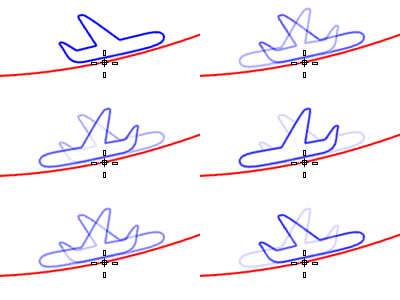
The OrientOnCrv command moves or copies and rotates objects along a curve using the curve direction for orientation.
### **Steps**
1. Select objects.
2. Pick a base point.
3. Select the orientation curve.
4. Pick a new base point on the curve
***
### **Command-line options**
**OnCurve**
Pick a base point on the curve. This allows moving the object along the curve while maintaining its orientation to the curve.
**Copy:** Specifies whether or not the objects are copied. A plus sign  appears at the cursor when copy mode is on.
The RememberCopyOptions command determines whether the selected option is used as the default.
**Flip:** Flips the direction of the oriented object on the target curve.
By default, the curve direction is used to orient the object.
**Perpendicular:** Orients the object perpendicular to the curve. The perpendicular plane is determined by the current construction plane when the base point is picked.
* **XFlip/YFlip:** Reverses the orientation relative to the original orientation to the construction plane.
* **Rotate:** Enter an angle or pick two reference points to rotate the object.
**SubCrv:** Type subcrv to select part of a curve as input.
***
For more information, please refer to the [Rhino documentation](https://docs.mcneel.com/rhino/8/help/en-us/commands/orientoncrv.htm).
---
# Agent Instructions: Querying This Documentation
If you need additional information that is not directly available in this page, you can query the documentation dynamically by asking a question.
Perform an HTTP GET request on the current page URL with the `ask` query parameter:
```
GET https://docs.rhinoartisan.com/commands/transform/orient/orient-curve.md?ask=
```
The question should be specific, self-contained, and written in natural language.
The response will contain a direct answer to the question and relevant excerpts and sources from the documentation.
Use this mechanism when the answer is not explicitly present in the current page, you need clarification or additional context, or you want to retrieve related documentation sections.
Orient On Curve
The OrientOnCrv command moves or copies and rotates objects along a curve using the curve direction for orientation.
### **Steps**
1. Select objects.
2. Pick a base point.
3. Select the orientation curve.
4. Pick a new base point on the curve
***
### **Command-line options**
**OnCurve**
Pick a base point on the curve. This allows moving the object along the curve while maintaining its orientation to the curve.
**Copy:** Specifies whether or not the objects are copied. A plus sign  appears at the cursor when copy mode is on.
The RememberCopyOptions command determines whether the selected option is used as the default.
**Flip:** Flips the direction of the oriented object on the target curve.
By default, the curve direction is used to orient the object.
**Perpendicular:** Orients the object perpendicular to the curve. The perpendicular plane is determined by the current construction plane when the base point is picked.
* **XFlip/YFlip:** Reverses the orientation relative to the original orientation to the construction plane.
* **Rotate:** Enter an angle or pick two reference points to rotate the object.
**SubCrv:** Type subcrv to select part of a curve as input.
***
For more information, please refer to the [Rhino documentation](https://docs.mcneel.com/rhino/8/help/en-us/commands/orientoncrv.htm).
---
# Agent Instructions: Querying This Documentation
If you need additional information that is not directly available in this page, you can query the documentation dynamically by asking a question.
Perform an HTTP GET request on the current page URL with the `ask` query parameter:
```
GET https://docs.rhinoartisan.com/commands/transform/orient/orient-curve.md?ask=
```
The question should be specific, self-contained, and written in natural language.
The response will contain a direct answer to the question and relevant excerpts and sources from the documentation.
Use this mechanism when the answer is not explicitly present in the current page, you need clarification or additional context, or you want to retrieve related documentation sections.