# Named Selections
##  Named Selections
The NamedSelections command opens the Named Selections panel that saves selection sets.
***
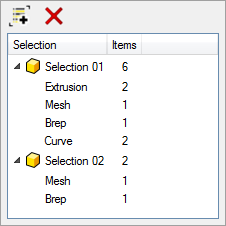
### Named Selections panel
#### 
#### **To save a selection set**
1. Select objects or sub-objects.
2. Click
Named Selections
The NamedSelections command opens the Named Selections panel that saves selection sets.
***
### Named Selections panel
#### 
#### **To save a selection set**
1. Select objects or sub-objects.
2. Click  .
3. Type a name for the selection, click OK.
The objects are listed by types under the named selection item.
Selection sets are saved in the 3dm file.
**To delete a selection set**
1. Select a selection set.
2. Click
.
3. Type a name for the selection, click OK.
The objects are listed by types under the named selection item.
Selection sets are saved in the 3dm file.
**To delete a selection set**
1. Select a selection set.
2. Click  .
**To replace, or add more objects to, a selection set**
1. Select objects or sub-objects.
2. Click .
3. Enter the name of an existing selection set.
4. When prompted, click Replace or Add.
**To use a selection set**
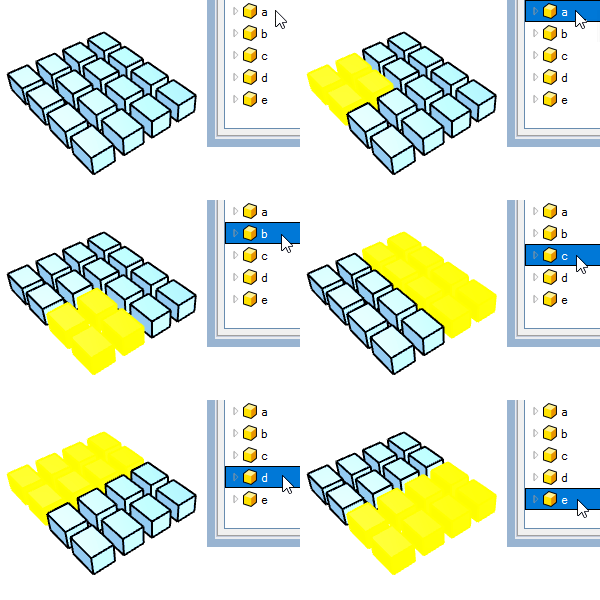
* Select a selection set before starting a command, or when a command prompts for selecting objects.
**To sort selection sets**
* Click the Selection column header to sort the parent items in ascending or descending order.
* Drag and drop a parent item name to a new location in the list.
* Duplicating all objects in a selection set also duplicates the selection set.
* Deleting all objects in a selection set also deletes the selection set.
* Subobject selection sets duplicate with their top object.
* Objects made into a block will be removed from selection sets.
* When all objects in a selection set are made into a block, the selection set will be removed.
**To access command-line options**
* Type a hyphen in front of the command name: -NamedSelections.
### Command-line options
**List**\
Outputs the selection set list to the command history window.
**Save**\
Creates a new selection set for selected objects.
**Select**\
Specifies a selection set to select objects.
**To script named selections**\
The scriptable -NamedSelections command can be run (nested) in other commands.
* Use :: (two colons) to separate the top and child levels.
* Names containing spaces have to be placed in double quotes.\
**Example:** -\_Move -\_NamedSelections \_Select "Selection 01::Extrusion" \_Enter 0 10,20\
This macro moves the Extrusion objects in the selection set of Selection 01 10 units in the x-axis and 20 units in the y-axis.
**Delete**\
Specifies a selection set to remove from the model.\
Objects in the selection set will not be deleted.
**Rename**\
Changes the name of an existing selection set.
**TabVisibility**\
Controls visibility of the Named Selections panel.
**TabVisible (Yes/No/Toggle)**\
Turns on, turns off, the Named Selections panel, or changes its visibility state.
**Replace (On/Off)**\
When the saved name exists, replace the existing named selection (On), or add more objects to it (Off).
***
For more information, please refer to the [Rhino documentation](https://docs.mcneel.com/rhino/8/help/en-us/commands/namedselections.htm?Highlight=namedsel).
---
# Agent Instructions: Querying This Documentation
If you need additional information that is not directly available in this page, you can query the documentation dynamically by asking a question.
Perform an HTTP GET request on the current page URL with the `ask` query parameter:
```
GET https://docs.rhinoartisan.com/commands/subd/selection/named-selections.md?ask=
```
The question should be specific, self-contained, and written in natural language.
The response will contain a direct answer to the question and relevant excerpts and sources from the documentation.
Use this mechanism when the answer is not explicitly present in the current page, you need clarification or additional context, or you want to retrieve related documentation sections.
.
**To replace, or add more objects to, a selection set**
1. Select objects or sub-objects.
2. Click .
3. Enter the name of an existing selection set.
4. When prompted, click Replace or Add.
**To use a selection set**
* Select a selection set before starting a command, or when a command prompts for selecting objects.
**To sort selection sets**
* Click the Selection column header to sort the parent items in ascending or descending order.
* Drag and drop a parent item name to a new location in the list.
* Duplicating all objects in a selection set also duplicates the selection set.
* Deleting all objects in a selection set also deletes the selection set.
* Subobject selection sets duplicate with their top object.
* Objects made into a block will be removed from selection sets.
* When all objects in a selection set are made into a block, the selection set will be removed.
**To access command-line options**
* Type a hyphen in front of the command name: -NamedSelections.
### Command-line options
**List**\
Outputs the selection set list to the command history window.
**Save**\
Creates a new selection set for selected objects.
**Select**\
Specifies a selection set to select objects.
**To script named selections**\
The scriptable -NamedSelections command can be run (nested) in other commands.
* Use :: (two colons) to separate the top and child levels.
* Names containing spaces have to be placed in double quotes.\
**Example:** -\_Move -\_NamedSelections \_Select "Selection 01::Extrusion" \_Enter 0 10,20\
This macro moves the Extrusion objects in the selection set of Selection 01 10 units in the x-axis and 20 units in the y-axis.
**Delete**\
Specifies a selection set to remove from the model.\
Objects in the selection set will not be deleted.
**Rename**\
Changes the name of an existing selection set.
**TabVisibility**\
Controls visibility of the Named Selections panel.
**TabVisible (Yes/No/Toggle)**\
Turns on, turns off, the Named Selections panel, or changes its visibility state.
**Replace (On/Off)**\
When the saved name exists, replace the existing named selection (On), or add more objects to it (Off).
***
For more information, please refer to the [Rhino documentation](https://docs.mcneel.com/rhino/8/help/en-us/commands/namedselections.htm?Highlight=namedsel).
---
# Agent Instructions: Querying This Documentation
If you need additional information that is not directly available in this page, you can query the documentation dynamically by asking a question.
Perform an HTTP GET request on the current page URL with the `ask` query parameter:
```
GET https://docs.rhinoartisan.com/commands/subd/selection/named-selections.md?ask=
```
The question should be specific, self-contained, and written in natural language.
The response will contain a direct answer to the question and relevant excerpts and sources from the documentation.
Use this mechanism when the answer is not explicitly present in the current page, you need clarification or additional context, or you want to retrieve related documentation sections.