# Mesh Intersect
##  Mesh Intersect
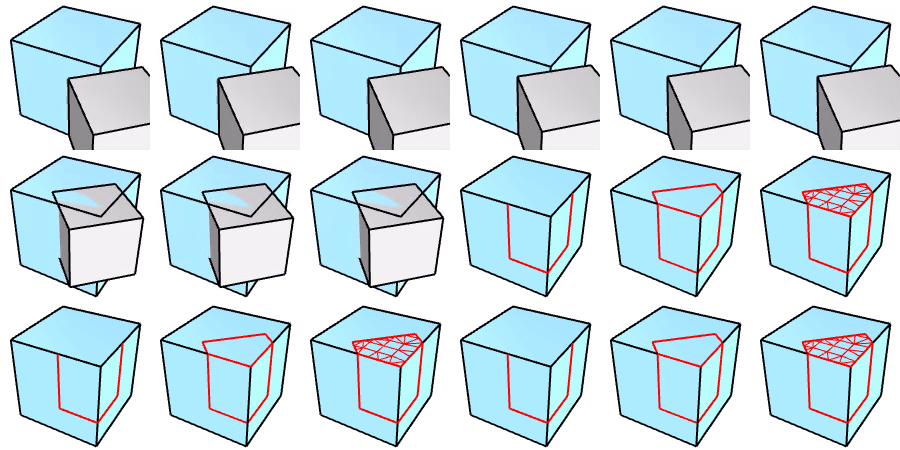
The MeshIntersect command creates a polyline at the intersection of mesh objects.
### Command-line options
### **Tolerance**
* **Auto:** Uses a tolerance that is more suitable for well-drawn meshes created using document tolerances. The value is computed using heuristics.
* **Literal:** Uses document tolerances. This might not be the best value because meshes often have tiny features that might fall well below the document tolerance.
### **CoplanarFaces**
* **Drop:** Discards coplanar overlaps.
* **Polylines:** Creates polylines from the boundaries of coplanar overlaps.
* **Meshes:** Creates meshes from coplanar overlaps.
Drop (left), Polylines (middle), and Meshes (right)
---
# Agent Instructions: Querying This Documentation
If you need additional information that is not directly available in this page, you can query the documentation dynamically by asking a question.
Perform an HTTP GET request on the current page URL with the `ask` query parameter:
```
GET https://docs.rhinoartisan.com/commands/mesh/mesh-analysis/mesh-intersect.md?ask=
```
The question should be specific, self-contained, and written in natural language.
The response will contain a direct answer to the question and relevant excerpts and sources from the documentation.
Use this mechanism when the answer is not explicitly present in the current page, you need clarification or additional context, or you want to retrieve related documentation sections.
Mesh Intersect
The MeshIntersect command creates a polyline at the intersection of mesh objects.
### Command-line options
### **Tolerance**
* **Auto:** Uses a tolerance that is more suitable for well-drawn meshes created using document tolerances. The value is computed using heuristics.
* **Literal:** Uses document tolerances. This might not be the best value because meshes often have tiny features that might fall well below the document tolerance.
### **CoplanarFaces**
* **Drop:** Discards coplanar overlaps.
* **Polylines:** Creates polylines from the boundaries of coplanar overlaps.
* **Meshes:** Creates meshes from coplanar overlaps.
Drop (left), Polylines (middle), and Meshes (right)
---
# Agent Instructions: Querying This Documentation
If you need additional information that is not directly available in this page, you can query the documentation dynamically by asking a question.
Perform an HTTP GET request on the current page URL with the `ask` query parameter:
```
GET https://docs.rhinoartisan.com/commands/mesh/mesh-analysis/mesh-intersect.md?ask=
```
The question should be specific, self-contained, and written in natural language.
The response will contain a direct answer to the question and relevant excerpts and sources from the documentation.
Use this mechanism when the answer is not explicitly present in the current page, you need clarification or additional context, or you want to retrieve related documentation sections.